

Xcite Uranium - anomalous radioactivity at Don Lake drives a doubling of the shares
One Canadian listed firm catching our attention this month is Xcite Uranium (CSE:XRI), an early-stage exploration company which is advancing a district-scale uranium portfolio in Saskatchewan.
The business
Xcite has six uranium projects (Beaver River, Lorado, Black Bay, Gulch, Don Lake and Smitty) across five contiguous property blocks covering 12,310 hectares in the historic Beaverlodge District near Uranium City in the Lake Athabasca region of Saskatchewan.
Occurrences of uranium mineralisation are abundant in the Uranium City area and have been explored and documented since the 1940s. The Beaverlodge camp was Canada's first uranium producer, generating 70.25 million pounds of U₃O₈ between 1950 and 1982 at an average grade of 0.23%. Since the early 1990s, limited exploration has been conducted in the Beaverlodge area but modern geophysics, improved geological understanding, and new discovery models present an opportunity for further exploration.
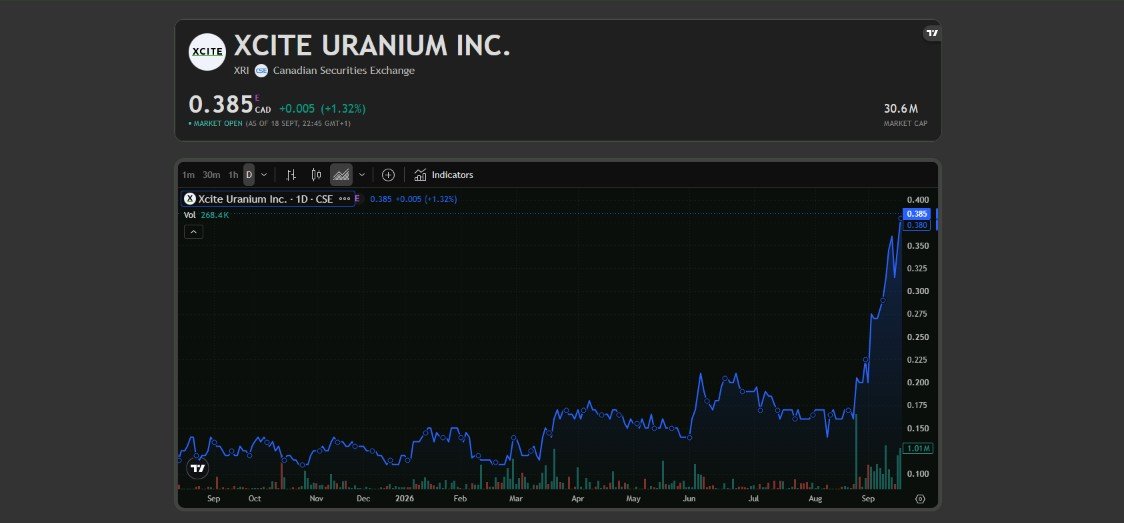
Exploration programmes ongoing and delivering positive results
Investors have taken note of the company in the past four weeks, the shares having more than doubled on a few pieces of significant news.
The big driver of the shares came on 26th August when Xcite revealed that anomalous radioactivity was found in the first three diamond drill holes to be completed at the current drilling programme at the Don Lake uranium project. Don Lake hosts near-surface uranium mineralisation, as well as a past-producing uranium mine. Historical exploration, including 14 trenches and 20 shallow drill holes, has outlined anomalous uranium mineralisation over c.213m of strike length.
The current 1,500m, 14-hole programme is testing for structurally controlled uranium mineralisation defined by both historical work and results from 2025-2026 field programmes. Results from the first three holes, completed in the A Zone area, included a peak hand scintillometer reading of 51,978 cps (counts per second) and downhole gamma probe intervals up to 34,254 cps.
A hand scintillometer is a handheld radiation detector that geologists run over the physical drill core once it is on the surface. Counts per second is the rate at which the device detects gamma radiation. Higher numbers mean more radioactivity, which usually, although not always, means there is more uranium. A reading of about 52,000 cps is very high, with ordinary background rock typically giving readings of only a few hundred cps.
Meanwhile, a downhole gamma probe is a sensor that is lowered into a drill hole to measure radioactivity in place, in the wall of the hole. Intervals up to c.34,000 cps means there were stretches down the hole reading at that elevated level.
Further, on 17th September, Xcite reported results from B Zone and C Zone drilling at Don Lake. Multiple intervals of anomalous radioactivity were intersected including 0.7m up to 29,586 cps in hole DN26008 and 2.2m up to 21,485 cps in hole DN26009, over c.525m of strike length in the A-B-C Zone area. We should point out that the exploration remains early stage, with these results not confirming grade or tonnage nor comprising a defined resource.
In other news, Xcite has commenced a 1,200m, 3-hole diamond drilling programme at the Lorado uranium project, testing for structurally controlled Beaverlodge-type and basement-hosted unconformity-style uranium mineralisation. The programme will test for uranium mineralisation defined by both historical work and results from the 2025-2026 field programmes. The Lorado uranium project is located 20km south of Uranium City and hosts near-surface uranium mineralisation as well as the past-producing Lorado uranium mine.
Market forces driving the uranium price
We will be looking out for further drilling results from the company, which is looking to benefit from structurally attractive factors in the uranium markets. The radioactive metal is a key input in nuclear energy, a market which after decades of underinvestment is experiencing a historic comeback as governments, corporations, and investors worldwide recognise that nuclear power is essential for meeting climate goals while providing reliable baseload electricity. Xcite Uranium is keen to highlight that current global uranium mine production covers only about 75% of reactor requirements, with the deficit being filled by rapidly depleting secondary sources.
After collapsing below US$20/lb in the years following the Fukushima disaster in March 2011, uranium has been in a structural bull market since around 2020/21. Xcite highlights that bank and analyst spot-price forecasts now cluster in the US$80–$150 range, while several specialist uranium investors argue that prices of US$150–$200/lb are achievable once utilities are forced back into the spot market to cover their needs. The spot price has reclaimed the mid-to-high US$80s in recent months, with the current price standing at US$89.7/lb. Xcite adds that, the long-term contract market that actually funds new mines is signalling that triple-digit prices are coming.
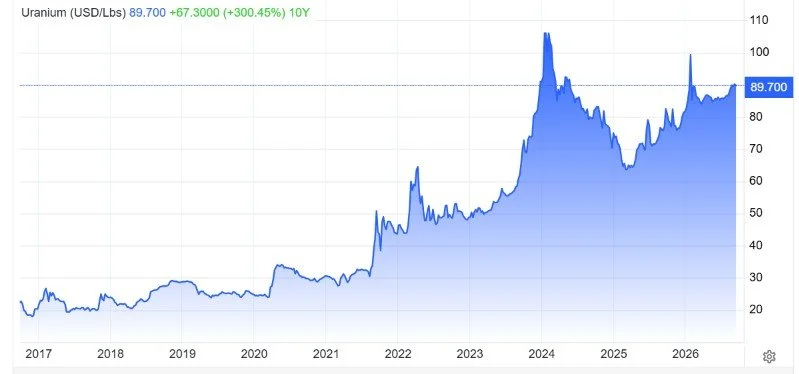
Uranium: 10 year price chart. Source: https://tradingeconomics.com/commodity/uranium
Sign up to receive our full investment research notes on small cap growth companies, as soon as they are published.
Disclosures
Xcite Uranium is not a corporate client of Optimo Research Ltd.
Disclaimers
This article, and all articles on the Optimo Research blog, are for information purposes only. Our blog articles do not constitute an investment recommendation or personal advice. Nothing in our blog articles should be construed as an offer or the solicitation of an offer to buy or sell securities by us and, as we have no knowledge of your individual situation and circumstances, you should not make any investment decision without consulting a fully qualified financial adviser. Your capital is at risk by investing in the financial instruments issued by the companies discussed. For full disclosures, disclaimers and risk warnings click here.