


The element rubidium is less well known than most commodities and rarely makes headlines, but a new report from Market Research Future suggests it deserves a closer look. According to the report, the rubidium market reached an estimated 7.44 tons in 2025 and is projected to climb from 7.79 tons in 2026 to 11.96 tons by 2035, a compound annual growth rate of 4.87%. While that growth might seem modest, the element is set to play a big role in some of the most advanced technologies being built today.
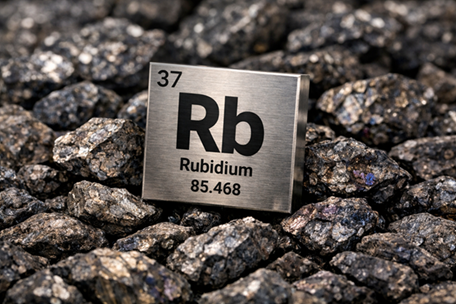
Rubidium is in the alkali metal group, similar to potassium and caesium, with symbol Rb and atomic number 37. It is a very soft, whitish-grey solid, first discovered in the early 1860s by German chemists Robert Bunsen (of Bunsen burner fame) and Gustav Kirchhoff. While being more abundant in the Earth’s crust (by mass) than copper, zinc and nickel, rubidium has more narrow practical applications, mainly due to its extreme reactivity. However, because it easily absorbs light and ionizes, it is valuable for experimental physics and other scientific applications. Rubidium has no ore where it's the primary economic target and instead is primarily extracted as a by-product of lithium or caesium mining.
Market Research Future’s top three rubidium market drivers are:
- 5G/6G atomic-clock deployment. This is expected to be the largest market driver, with every 5G macro base station needing a precision clock. Rubidium oscillators have become an option between expensive caesium standards and cheaper crystal alternatives. With over 15 million base stations expected worldwide by 2028, even modest deployment rates should translate into noticeable growth in demand.
- Quantum computing. Neutral-atom processors from firms like QuEra, Pasqal, and Atom Computing use laser-cooled rubidium-87 atoms as qubits. As these systems scale past 1,000 and eventually 10,000 qubits, per-machine rubidium consumption could rise sharply.
- Rb-82 PET cardiac imaging growth. Rubidium-82 generators power cardiac PET scans that outperform older SPECT imaging, and scan volumes have grown roughly 14% annually since 2023.
Geographically, Asia-Pacific dominates the rubidium market with about 42.2% of global volume, driven by China's integrated lithium and rubidium refining. That concentration is also the market's biggest vulnerability, with an estimated 70 to 75% of high-purity refining capacity sitting in Chinese complexes. So it’s no surprise that countries such as the US, which are import dependent, are looking to secure supplies of the critical mineral. President Trump has galvanised the US government to intensify efforts to develop domestic critical minerals, reducing dependence on imports from China. The US does not currently mine rubidium. As stated above, there is growing demand as the metal is critical in a host of applications like quantum computers, photonics, AI, green energy, along with medical imaging and defence.
The Market Research Future report does flag risks to its forecasts, including competition from emerging optical clock technology and the market's small absolute size.
Peloton Minerals
One company with exposure to this theme is Canadian mine developer Peloton Minerals (CSE:PMC, OTCQB:PMCCF). In March this year the company reported that drilling on its flagship North Elko Lithium Project (NELP) in Nevada discovered rubidium (and caesium) in all of the first four drill holes. Peloton is working to integrate the numerous datasets (airborne, surface, and subsurface work) to refine drill targets for a follow-on programme this summer.
For more information about Peloton Minerals visit the company’s dedicated Optimo Research page HERE
Sign up to receive our full investment research notes on Peloton Minerals, and other small cap growth companies, as soon as they are published.
Key sources used
1. Market Research Future - Rubidium Market Research Report Information By Production Process (Lepidolite, Pollucite, and Others), By Application Sector (Specialty Glass, Electronics, Biomedical Research, Pyrotechnics, and Others) – Forecast Till 2035. https://www.marketresearchfuture.com/reports/rubidium-market-27298
3. https://www.sciencedirect.com/science/article/abs/pii/S002231151930426X
4. https://en.wikipedia.org/wiki/Abundance_of_elements_in_Earth%27s_crust
Disclosures
Peloton Minerals is a corporate client of Optimo Research Ltd and Optimo Capital Limited.
Disclaimers
This article, and all articles on the Optimo Research blog, are for information purposes only. Our blog articles do not constitute an investment recommendation or personal advice. Nothing in our blog articles should be construed as an offer or the solicitation of an offer to buy or sell securities by us and, as we have no knowledge of your individual situation and circumstances, you should not make any investment decision without consulting a fully qualified financial adviser. Your capital is at risk by investing in the financial instruments issued by the companies discussed. For full disclosures, disclaimers and risk warnings click here.