

Our client Krait Critical Minerals Corp. (CSE: KRIT) (FSE: U0S) has entered into a mineral property purchase agreement with Cannon Bridge Mining Services Inc., pursuant to which Krait has been granted an exclusive option to acquire a 100% interest in the historic Dixon Tungsten-Manganese Project. The project comprises six contiguous unpatented federal lode mining claims approximately 13 kilometres (8 miles) east of Carson City, Nevada.
The proposed acquisition would expand Krait's North American exploration portfolio into tungsten and manganese, alongside its existing gold and antimony interests in Ontario, Washington State and Nevada.
The Dixon occurrence was investigated by the United States Geological Survey (USGS) in the early 1940s. Government records describe tungsten-bearing manganese oxide mineralization in altered rhyolitic rocks, historical sampling and two underground exploration adits.
About Krait Critical Minerals Corp.
Krait Critical Minerals Corp. is a Canadian exploration company advancing its Goldbar Spider Lake Gold Project in Ontario and evaluating gold and critical mineral opportunities in North America.
At Goldbar Spider Lake, in the western Schreiber-Hemlo Greenstone Belt, Krait has an option to earn a 100% interest in a 3,636-hectare property comprising 148 claims and 171 claim units, subject to a 3% net smelter return royalty.
Krait acquired Nevada Hills Antimony LLC on September 16, 2026, through which it holds interests relating to the Bales Antimony and Antimony Bell projects in Washington State. On October 19, 2026, it also entered into an option agreement with Sierra Antimony Corp. to acquire a 100% interest in 17 contiguous unpatented claims (approximately 354 acres) in Humboldt County, Nevada, subject to the agreement's terms.
Get our research notes free, the day they're published
In-depth coverage of UK small caps and junior miners. Email only, unsubscribe any time.
Property Highlights
Nevada location and claims: Six contiguous DXT 1-6 lode claims cover the historically documented prospect about 13 kilometres east of Carson City in the Hackett Canyon-Fiddlers Green area.
Government documentation: USGS mapping and investigations in 1943 recorded geological observations, sampling and underground workings.
1941 tungsten sampling: J.H. Heizer of Rare Metals Corporation reportedly obtained an average of approximately 0.7% tungsten trioxide (WO₃); sample distribution and analytical methods have not been verified.
USGS sampling: Two historical samples reportedly returned 0.21% and 0.39% WO₃, together with 11.57% and 24.78% manganese oxide (MnO), respectively.
Historical workings: Records describe a lower crosscut approximately 120 feet (36.6 metres) long and an upper crosscut approximately 40 feet (12.2 metres) long, about 35 feet (10.7 metres) above it.
Modern evaluation required: Geological mapping and systematic sampling would be needed to verify historical information and assess mineralization.
All historical results are unverified by Krait's Qualified Person, may not be representative of the Property, and do not establish current mineral resources or mineral reserves.
Oscar Mendoza, President and Chief Executive Officer of Krait Critical Minerals, commented: "The proposed acquisition of the Dixon Tungsten-Manganese Project represents another important step in Krait's strategy of building a diversified portfolio of North American critical mineral exploration opportunities. Tungsten and manganese are strategically important materials used across a broad range of industrial, manufacturing and defence applications, and we believe that historically documented occurrences such as Dixon warrant careful technical evaluation.
"What makes Dixon particularly interesting is the extent of the historical geological documentation. The property was examined by government geologists, historical sampling identified both tungsten and manganese, and underground workings provide additional information about the geological setting. These records offer a starting point for modern geological evaluation.
"As North American industries and governments place increasing emphasis on strengthening domestic critical mineral supply chains, we believe opportunities to investigate historically identified mineral occurrences in established mining jurisdictions are particularly relevant. Our objective will be to apply a disciplined, technically driven approach to determining whether the historical results can be substantiated and whether further exploration is justified," added Mendoza.
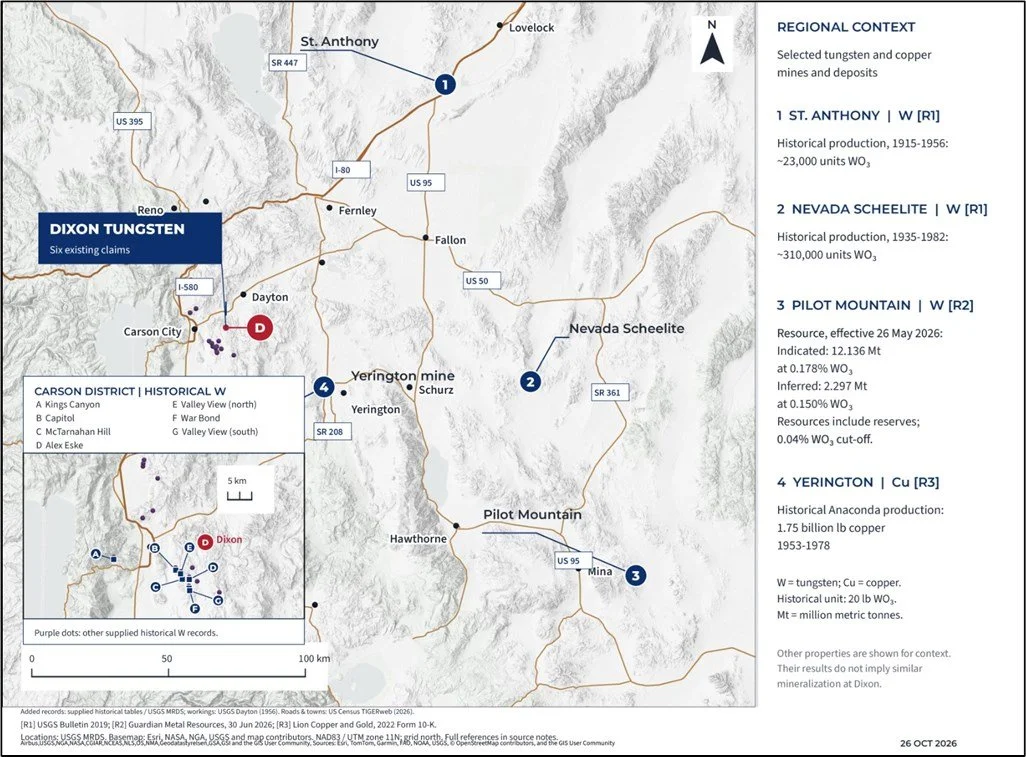
Figure 1: Dixon Project regional location map, showing the six claims east of Carson City and selected historical Nevada tungsten properties.
Dixon Tungsten-Manganese Project
The Dixon Project comprises the DXT 1-6 claims in the Hackett Canyon-Fiddlers Green area of western Nevada. The prospect is referenced in historical geological publications and USGS Mineral Resources Data System (MRDS) records 10043765 and 10296288.
The MRDS entries provide historical identification of the Dixon prospect.8
Regional mineral occurrences and historic production are provided for geological context only and are not indicative of results at Dixon.
Existing roads and tracks provide access to the general area, but their suitability for future exploration remains to be assessed.
Historical Exploration and Geological Setting
Originally explored for manganese in the 1930s and early 1940s, the Dixon prospect was subsequently investigated for tungsten associated with manganese oxide mineralization.
In 1943, USGS geologists M.R. Klepper and P. Joralemon mapped and sampled tungsten-bearing manganese oxide mineralization within locally brecciated, intensely silicified rhyolitic volcanic rocks.
Historical descriptions identify flow-banded rhyolite and lithic rhyolite tuff, locally associated with intrusive material. Tungsten-bearing manganese oxide veinlets reportedly cement breccia zones near a rhyolite-tuff contact.
Historical mapping described a mineralized exposure approximately 60 feet (18.3 metres) along strike and averaging 15 feet (4.6 metres) in width. The investigators also suggested that mineralization in the lower workings could be structurally displaced from the surface zone. These unverified interpretations require modern mapping and sampling.
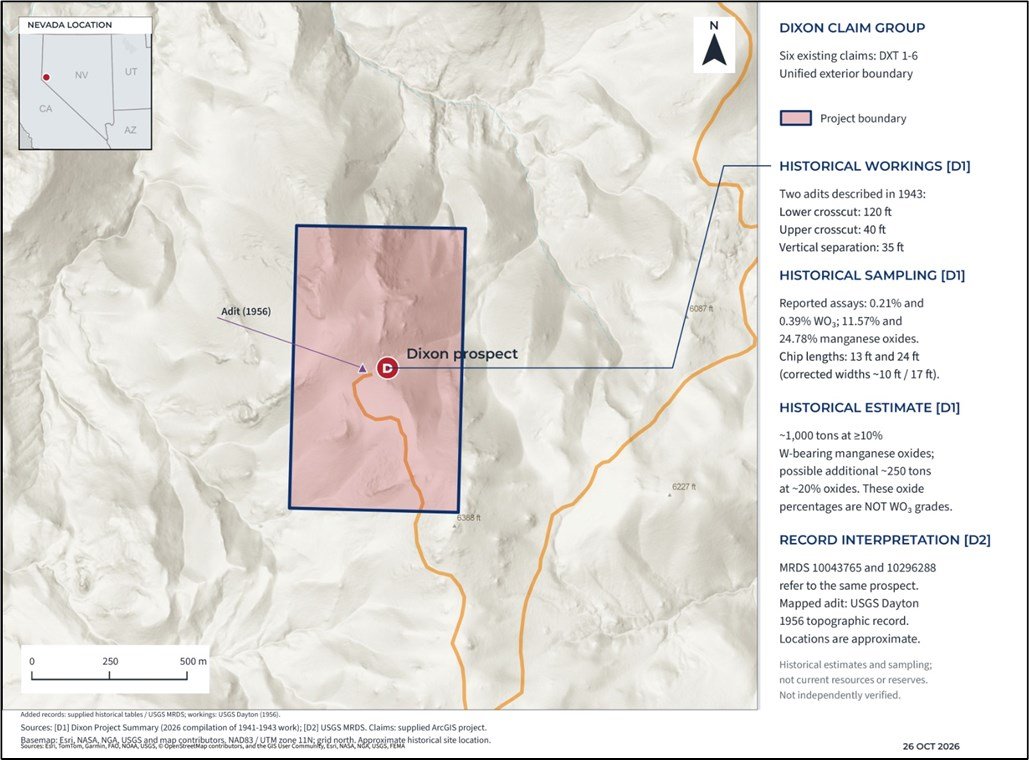
Figure 2: Dixon DXT 1-6 claim boundary and approximate location of the historically documented prospect and two underground adits.
Historical Tungsten and Manganese Sampling
Two historical USGS samples reportedly returned the following results:

Source: Historical USGS and Nevada Bureau of Mines and Geology records.
Historical descriptions also report the following underground sampling widths:
Lower crosscut (120 feet/36.6 metres): A reported chip sample across approximately 13 feet (4.0 metres), with a historically corrected width of about 10 feet (3.0 metres).
Upper crosscut (40 feet/12.2 metres): A reported chip sample across approximately 24 feet (7.3 metres), with a historically corrected width of about 17 feet (5.2 metres).15
Historical sample locations, methods and widths have not been independently verified; the corrected widths are not confirmed true widths. The limited sample results do not represent average Property grades. MnO analytical values should not be confused with elemental manganese (Mn) grades.
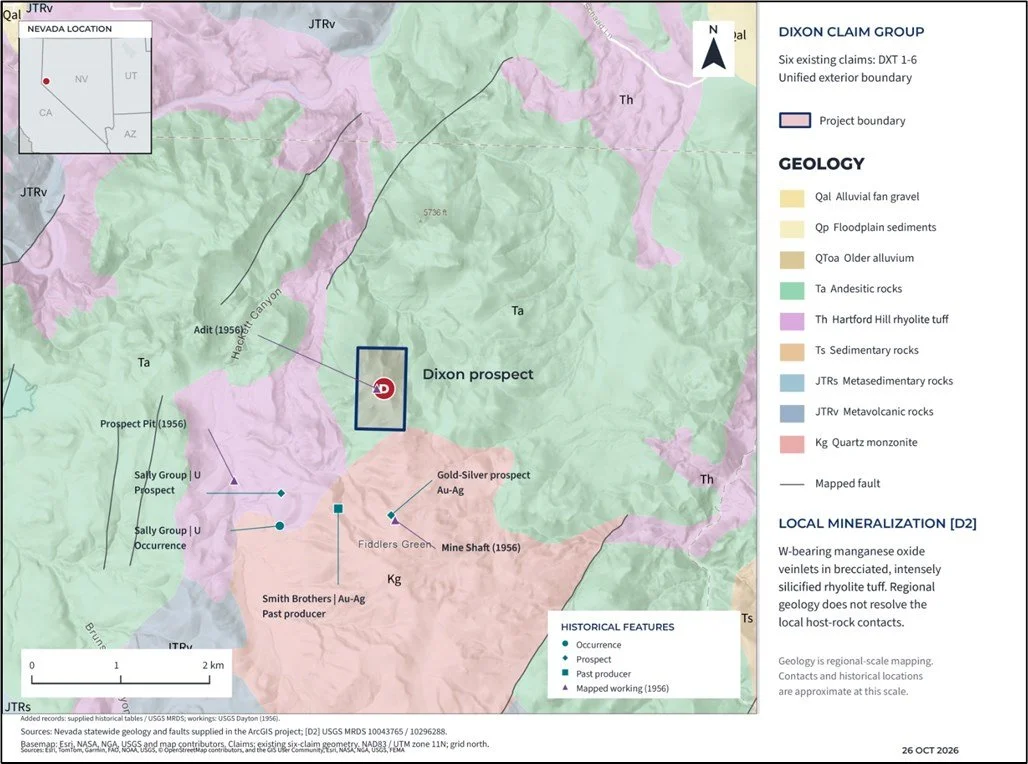
Figure 3: Geological map showing the Dixon DXT 1-6 claims, principal rock units, mapped faults and nearby historical occurrences.
Historical Mineralized Material Descriptions
A 1943 government investigation described approximately 1,000 tons of material between the upper adit and surface containing an estimated minimum of 10% tungsten-bearing manganese oxides.
The same investigation suggested approximately 250 additional tons of material above the lower adit containing about 20% oxide material.16
These historical percentages refer to estimated tungsten-bearing manganese oxide material, not WO₃ or elemental Mn grades.
The tonnage descriptions predate National Instrument 43-101 - Standards of Disclosure for Mineral Projects (NI 43-101) and are provided solely as historical exploration information, not as current mineral resources or mineral reserves.
Original estimation methods, geological supporting data, density assumptions, classification criteria and verification procedures are insufficiently documented for assessment under modern reporting standards. A Qualified Person has not done sufficient work to classify these historical estimates as current mineral resources or mineral reserves, and Krait is not treating them as such. Investors should not rely on the figures as evidence of current mineral quantity, grade or economic recoverability. No current resources or reserves have been established at Dixon.
Regional and Critical Minerals Context
Nevada has a history of tungsten exploration and production. Historically documented examples include St. Anthony, Nevada Scheelite and Pilot Mountain, shown for regional context in Figure 1.
Those properties are separate from Dixon, and their historical production, resources or exploration results are not indicative of mineralization at Dixon. Tungsten is used in cutting tools, industrial machinery and defence applications, while manganese is used primarily in steelmaking and also in specialty alloys and battery materials.
Terms of the Option Agreement
Under the Agreement dated November 2, 2026, Cannon Bridge granted Krait an exclusive option to earn and acquire a 100% ownership interest in the Property. Cannon Bridge holds an underlying option from Stream Metals LLC to acquire the Property and must exercise that option before or concurrently with Krait's acquisition of title.
Cash Consideration
Krait is required to pay Cannon Bridge aggregate cash consideration of US$120,000,based on the payment schedule as follows:
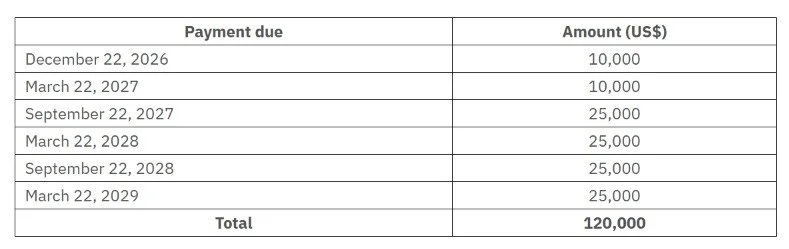
Each cash payment is non-refundable when made, and Krait may prepay any outstanding amount without penalty. If Krait misses a payment, Cannon Bridge must give written notice and a 30-day opportunity to cure before it may terminate the option, subject to the Agreement's force majeure provisions.
Royalty
Upon vesting, Cannon Bridge or its permitted assigns will receive an aggregate 2.0% net smelter return (NSR) royalty on all minerals and mineral products produced and sold from the Property. Krait will have a one-time right to repurchase 1.5% of the NSR for US$1,000,000 in cash, leaving an unreducible 0.5% NSR.
The transaction remains subject to the Agreement's terms, applicable law and relevant Canadian Securities Exchange policies.
Planned Exploration and Evaluation
Krait expects to review available geological information before determining whether mapping, prospecting, geochemical sampling or geophysical surveys are warranted. Any fieldwork will be subject to technical assessment, access, permitting and management approval. Further updates will be provided as appropriate.
Historical Information and Technical References
Historical geology, sampling, widths and mineralized-material descriptions were compiled from government records and technical publications and have not been substantiated by modern exploration. They provide context only and should not be taken as evidence of current resources, reserves or economic viability.
Sign up to receive our full investment research notes on small cap growth companies, as soon as they are published.
Disclosures
Krait Critical Minerals is corporate client of Optimo Research Ltd and Optimo Capital Limited.
Disclaimers
This article, and all articles on the Optimo Research blog, are for information purposes only. Our blog articles do not constitute an investment recommendation or personal advice. Nothing in our blog articles should be construed as an offer or the solicitation of an offer to buy or sell securities by us and, as we have no knowledge of your individual situation and circumstances, you should not make any investment decision without consulting a fully qualified financial adviser. Your capital is at risk by investing in the financial instruments issued by the companies discussed. For full disclosures, disclaimers and risk warnings click here.